Search

postmodernfamilyblog

Multigenerational Mom Muses on Twin Toddlers & Twenty-Something Daughters

Month

August 2020

The Most Critical of Workers are Reporting for Duty: Students in the Pandemic

As school starts back, we have a whole new essential workforce hitting the frontline in the pandemic. Teachers were labeled critical workers by the POTUS. And that is as it should be. We are willing and able to meet the challenges ahead — especially with a dedicated and conscientious school system supporting us. 

But I’m here to call attention to another group of critical workers out there — a group vital to the core function of society and the entire future of our great nation. A group of young, unsung heroes willing to do whatever it takes to succeed under strange and difficult demands. 

I’m talking about our students.

The changes these kids are facing — and embracing — are enough to rattle the steadiest of veterans. Our school has opened on a hybrid schedule, leaving us at half capacity inside our walls, with kids reporting both in person and virtually at different times throughout the week. The hallways and stairwells have one-way signs, there are hand sanitizer stations every fifty feet, lunches are eaten inside classrooms, masks are worn when social distancing isn’t possible, and desks face one direction and sit six feet apart.

But these kids of ours — these superhero Gen-Z go-getters — they are taking all these hurdles in stride just to be here and be educated in far-from-ideal and so-far-from- normal conditions.

And they’re doing it with smiles on their faces. Not that I can see their mouths, thanks to the masks they wear so willingly — but I can see those smiles in their eyes. And they can see mine. Or I truly hope so. Because I love being with them again, interacting, forging relationships, watching light bulbs click on, discussions unfold, learning ignite. 

Now don’t get me wrong, it’s far from easy peasy Lysol squeezy. Despite our school system creating one of the best re-opening plans I’ve seen out there, I’m not gonna lie, things feel weird. Because being socially distanced to keep us all together is messing with the normally exaggerated and wide-open personalities of my teen students.

I’m sure some of it has to do with the trauma of the past four months — the PTSD of losing classrooms and classmates and social lives literally overnight. And I’m sure a large part also has to do with the smaller class sizes and the masks we wear.

But y’all… I’m used to kids who like to talk. Who, if anything, talk too much most of the time. They’re teenagers. On the cusp of adulthood. It’s a confusing stage under normal circumstances. So they talk through their confusion in class A LOT… way more than they do at home. They feel freer to vocalize thoughts, feelings, dreams, and fears. And through their persistent chatter, formal class discussions, and best-friend heart-to-hearts, they learn who they are, what they know, what they believe, and where they stand in life. And I love that about teenagers. 

Like, really. I’m not lying. Some teachers love it when their students are silent. But me, I love it when they’re not. When they feel comfortable and safe enough to give voice to their rapidly-evolving thoughts and feelings. 

But this year, they are quiet. Eerily so — as if the masks are acting as mufflers. 

And not just for them. Me too. 

I teach because I love to make connections, to share literature and love and learning with young people so they know and understand their worth and potential. My goal is always to make a positive impact. 

But this year, my impact feels muffled, like my best efforts are falling on… not quite deaf ears, but more like mute mouths. Our kids, I think, feel vulnerable and isolated and self-conscious. 

But then, these kids are also brave. Brave and here. At school. In a brick and mortar building. Present and determined. They make me prouder than they’ll ever know. 

I wish I could put into words how much I love them. How far I am willing to go to help them succeed. How much they inspire me to be the best possible teacher — because they deserve only the very best. 

As our superintendent says, this school year should be seen not as a challenge, but as an opportunity. An opportunity to grow and become better at our craft. I want to be a better communicator and a better teacher — to bridge the social distancing distance and reach my students. And teach my students. And see them grow. 

I will rise to that opportunity, and I will seize it with both hands (well-sanitized, of course).

Because my students are willing to do the same. 
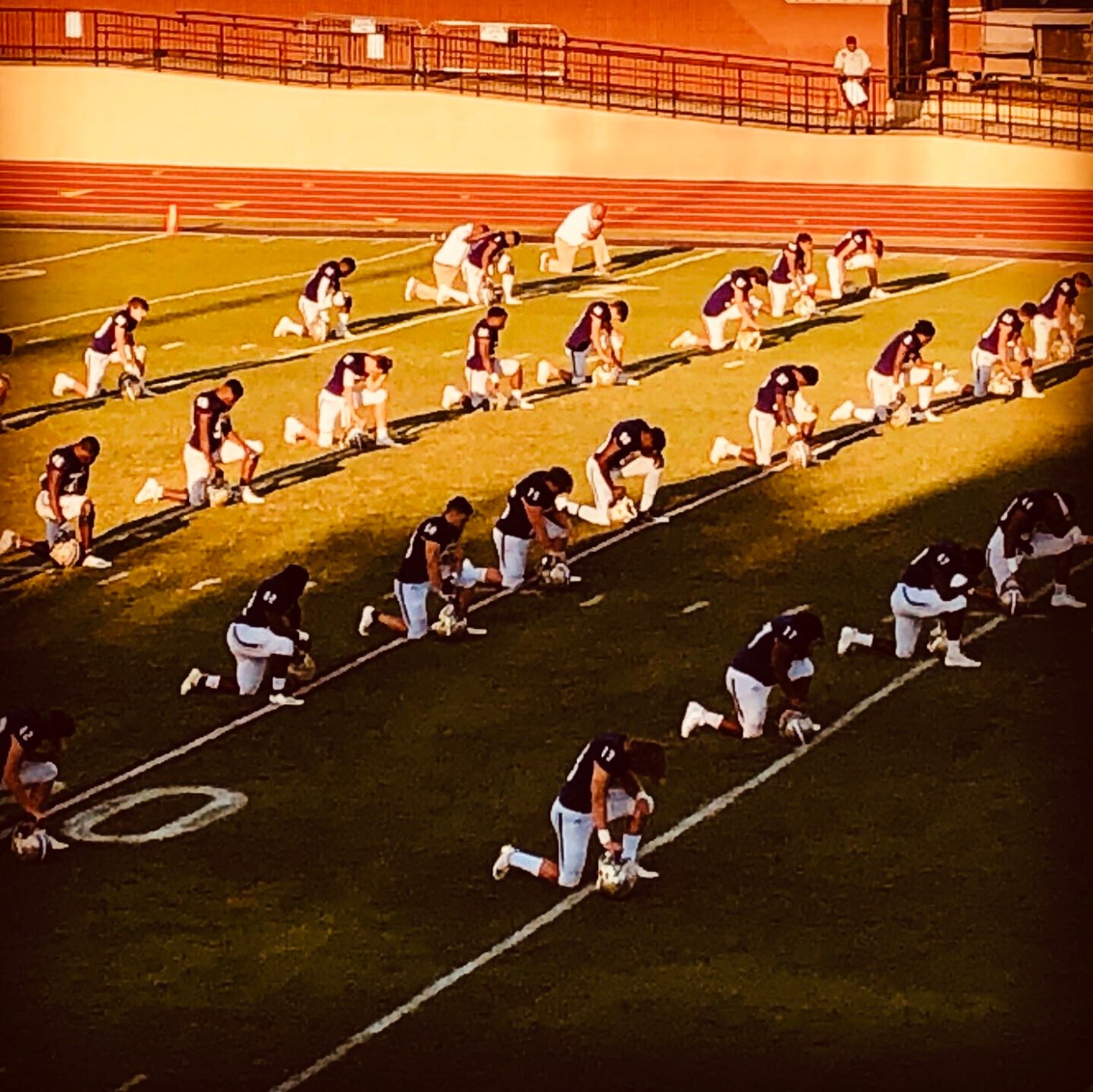
The Alchemy of Football: Spinning Straw into Gold

Football players know how to spin straw into gold. They know how to take the tough times and hard hits and turn them all into victory. Into pure gold.

Football has proven to me that alchemy exists. Remember alchemy? The science of legend and starry-eyed madness — that Middle Ages’ fever to turn base matter into precious metal?

It can be done. Football has discovered the secret. But there’s no short-cut, no cheating, no sleight-of-hand or fairy dust or smoke and mirrors. It takes months and months and years and years of dedication, sacrifice, discipline, and hard work.

The transformation is real, but not everybody makes it through to the other side. The process is hard. The grind is grueling. And if you survive it, you transcend it. And the result is pure gold.

But this year, the alchemy may be interrupted.

The hard work — the blood, sweat, tears put in during the off-season — may all get upended. Snatched away before the first opponent is faced. Snatched away by a virus that has completely transformed the world into something none of us recognize. A kind of reverse alchemy where conversation becomes altercation, faith reduced to condemnation, politics spun to propaganda — fueling shutdowns and shouting matches. A virus ending with so much death — of people, civility, relationships.

And in the aftermath of this virus, in an upside-down world, we may lose football for a season.

Robert Frost penned a famous poem about how quickly beauty and youth and life can pass us by — how “Nothing Gold Can Stay.” But I refuse to believe that. Beauty may be fleeting, and youth and life as well, but character is steady. Character remains.

That character is particularly evident in the new movement currently underway to give players input in decision making. One of the leaders of this newly-established #WeWantToPlay initiative is Trevor Lawrence, a player with well-established, 24 karat character.

Trevor is leading the charge to allow Power 5 conferences to play football. His points are valid and well-articulated. These schools have abilities that smaller colleges (and high schools) don’t have. They have the funds to take proper precautions and place programs in bubbles that will isolate and monitor players, their contacts, and their health. While there are still risks, these colleges’ situations are as ideal as it’s possible to be right now.

Still, there would be sacrifices. Beyond the risk of actual contraction are the documented after-effects of COVID-19, including potentially life-altering heart complications. These young adults are willing to make the sacrifice. They are adults, after all. They should have a say. Their voices should be heard.

High school football is another story entirely.

My family is involved with high school football. Our players are not adults. They do, however, know and understand sacrifice. Both the boys and their coaches have sacrificed a lot for the season already — and now they may end up sacrificing their season. It’s a sacrifice they never saw coming; one nobody signed up for.

Sacrifices are hard. In a normal year, football demands countless hours of sweat, blood, tears, bruises, sore muscles, brain power, and lost family and social time. This year, the sacrifices could be far more.

There are no easy answers. Some will have a voice in the choices of sacrifices. Others will not.

But if I’ve learned anything about football, it’s that sacrifice renders gold. If the Power 5 conferences have football, those players and their coaches will spin straw into gold.

And if high school and the smaller conferences don’t have a season, they, too, will spin straw into gold.

Even if the alchemy of football is interrupted… its magic will not be reversed. It will not be halted. It will persist and proclaim itself victorious. These young men and their coaches will come out on the other side stronger.

For all involved in football programs, it’ll sting — and way more than a little bit. It’ll hurt — a lot. For us, football IS fall. But the loss (or unexpected win) of a season won’t cause any of these coaches and players to fall. They know sacrifice. They’ve overcome pain and hardship before.

Because the gold of football is not in the wins, in the trophies or championships, in the college careers or NFL draft picks.  No, the pure gold that is forged from football is strength of character. So while the spent blood, sweat, and tears of the off-season may come to nothing, it won’t really come to nothing. Not really.

These players and coaches — from high school to college– have gold pumping in their hearts, fueling their souls, and lighting their wisdom. They are strong, brave, principled, driven, and more flexible than a game plan at halftime.

With or without a season, these programs will be victorious.Their gold will stay.

And even better, their gold will help lead the way out of this dark age and back into light.

Blog at WordPress.com.

Up ↑