Search

postmodernfamilyblog

Multigenerational Mom Muses on Twin Toddlers & Twenty-Something Daughters

Author

postmodernfamilyblog.wordpress.com

I'm a mother of twin toddlers and two adult daughters. My dad says I ran the engine and the caboose on grandchildren, but I'm having a really hard time driving the potty train. (They always told me boys were harder!) I am passionate about family, football, politics, and good books, and I'm liable to blog about any one of them on any given week.

My Experience with Undocumented Students: Why I Love our Dreamers

I’ll never forget my student who explained to me how he came to America for an education.  He raised his hand politely when we were discussing the negativity in our hallways following Trump’s election. He had overheard students chanting “Build that Wall.” He overheard students telling other students to go back where they came from. He overheard one student boldly hold up her head and explain that she wasn’t Mexican and she wasn’t illegal. My student walked quickly past. He was both.

Back in my classroom, he felt safer. He felt braver. He explained to me and to his classmates that he had come from Mexico ten years prior with his father and his uncle while the rest of his family had stayed behind. He missed them all terribly, but the entire reason for coming to this country was so he could get a quality education. Back home, he explained, that was not possible. There were classrooms without electricity. There were schools without running water. If you wanted math skills beyond a fourth-grade level, he explained, you had to pay for private school. His family didn’t have that kind of money.

So he and his father and uncle came to America. He studied and he learned. He struggled – sometimes with the material, but most times with the hate. He just wanted people to understand.

He is one of the kindest-hearted, hardest-working students I’ve ever taught. He is exceptional, but he is not an exception. I’ve taught many students like him. Students who know and understand the value of education. Students who come to America to come to school, to sit quietly, to do their work, and to soak up any and all knowledge they possibly can. I wish I had more students like them. I would gladly fill my classroom with dozens of these young men and women. They know and understand what the world looks like without access to education.

It looks like poverty. It looks like violence. It looks like drug cartels and narcotic trafficking. It looks like where they came from. And they want change. For themselves, for their families, for their country.

So they work. Hard. They learn. Well. They are respectful and teachable, and tough. They don’t whine when they don’t get an A. They work harder. They come for tutoring. They ask for remediation. They never ask for a grade. They work for one.

The same can’t be said for perhaps seventy percent of my natural-born students. There has been a drastic shift in the mentality of parents and students in the United States in the seventeen years I’ve been a teacher. Parents call and email regularly these days with complaints. They aren’t happy with little Johnny or Jill’s grade They gripe and complain and bellyache that we aren’t fair, we’re too tough, we’re on power trips, we aren’t accommodating enough. Their children gripe and complain and bellyache, as well. Parental attitudes passed down like genetics, multiplying like a cancer.

Somewhere along the way, the idea of the American Dream has gotten soft and fuzzy. We used to have a Puritan work ethic, a nose-to-the-grindstone mentality that built our nation into the powerhouse it used to be. These days, our work ethic is pitiful, not Puritan.  Folks seem to believe they can sleep walk through their lives and simply reap the benefits of being American: good education, good jobs, good pay, good living conditions.

I see it in my classroom every day. Kids who want everything handed to them: the notes, the answers, the grades.

And this lazy philosophy, this twisted version of the American Dream, is currently on display in our oval office: a spoiled rotten and ranting adult-sized child who’s never worked an honest day in his life and who finds fault in anyone and everyone but himself.

Our American Dream has mutated into an American Nightmare.

Yesterday, Trump destroyed the authentic dreams of thousands of young adults like my student, individuals who understand and embody the true nature and characteristics of the American Dream — hard work and sacrifice — better than most of their American counterparts. Their only fault is they aren’t American.

Then again, didn’t our forefathers house the exact same fault? Didn’t they arrive on America’s shores searching for a better life as strangers in a strange land?

The decision to end DACA has tremendous repercussions on honest, hard-working, deeply committed individuals who have the potential to improve the world in immeasurable quantities if only they are allowed access to the ways and means to do so: education.  Individuals like my precious student.

Which brings me back to those parental complaints a few paragraphs back, I tend to agree with them. We aren’t fair; we are on power trips; we are not nearly accommodating enough — to those who are willing to work for the American Dream and understand its potential the most: our young, undocumented immigrant students.

Contact your representatives. Let them know you stand with DACA and our undocumented immigrant students. Please.
When your Opponent Blusters and Blows, but you Have Promise on your Sideline

Sitting out on my back porch, typing my blog for the week, a hummingbird came to visit. He hovered just over my right shoulder, his wings humming frustration in my ears. You see, his feeder was empty – still is, actually. And he was voicing his frustration through whispers of angry, agitated air.

He was frustrated, but I was fascinated. His wings, soft and rumbly as a cat’s purr, a bumblebee’s snore, a raspberry buzzed on a baby’s round belly. A rainbow’s shimmer in his puffed, iridescent chest.

I could see him in the reflection of my laptop. His needle-thin beak turned slightly to the left, giving me the cold shoulder — but making absolutely certain I could see how pissed he was.

He hung there in my screen for maybe twenty seconds, stirring the air with his displeasure, amusing me with his antics, before buzzing away.

Our football team faced an equally pissed and impotent nuisance this week in a decades’ long, close-town rivalry game.

Like a hummingbird harangue, the opposing team raged against the machine that is our offense, making absolutely certain we could see how pissed they were. They hung on our screens all week long – stirring the air on Twitter with their hissy fits and buzzing barbs. They slung zingers and threatened with their stingers in a futile attempt to rattle our players and defame our team character.

Their social media predictions beg a communism analogy: looked good on a screen-shot; fell horribly flat in reality.

You see, after our lopsided victory last year, they were frustrated and fired up. We were just fired up.

Our boys used their frustrations as fodder. They may have come hungry, but we’re the ones who feasted.

There are several similarities between my little hummingbird’s attempt at scoring the sweet nectar of victory and our winged opponent’s.  Both vented their frustrations into the airwaves. Both were ultimately as nonthreatening as a bumblebee’s snore.

And both went home disappointed.

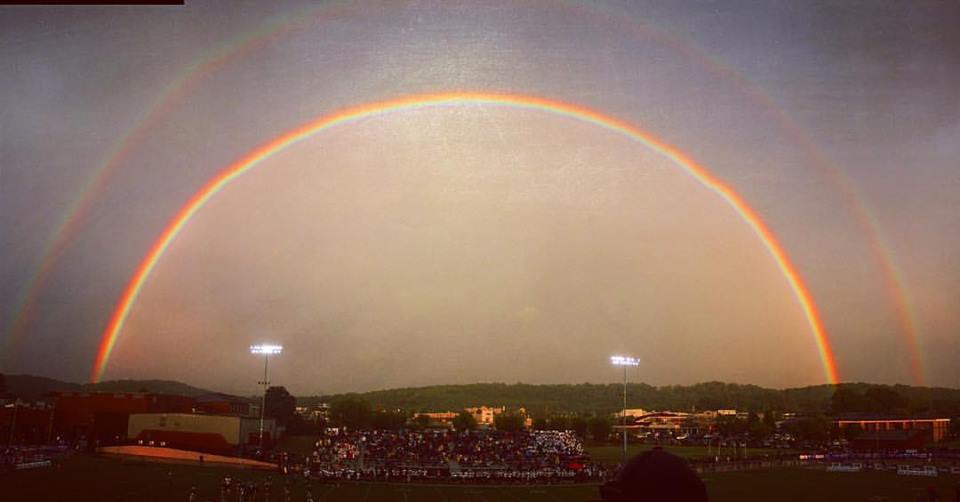
Oh, and one final similarity — that rainbow’s shimmer in my hummingbird’s puffed up, iridescent chest? Yeah, it was merely the shadowy reflection of the glorious harbinger of back-to-back victories that flared over our home stadium in the first quarter last night.

Rainbows symbolize promise. And this one was a double — two of them, people — stacked one atop the other. As in back to back.

They never even had a chance.


Teaching English Composition: The Delicate and Demanding Job of a Voice Midwife

On dark days, I wonder why I blog.  Why I put myself through the peeling back of layer after layer of tender, hidden embryonic self-truths, exposing the fresh new bits to a cold, fickle world…

And no matter how much I tell myself it doesn’t matter whether my musings are acknowledged and well-received, it does. It matters a lot. Because everyone wants to be heard. Everyone wants to feel valued and validated. And when it doesn’t happen, it brings on floods of insecurities and self-doubt. Especially after the painful process of self-revelation.

It makes me question why I blog about my life at all? What do I have of value to offer up to the world? I’m not young and good looking. I’m not rich and famous. I’m no makeup expert or flashy fashionista. And I’m certainly not a ninety-something grandma in tie dye lingerie smoking weed and dancing the Charleston to gangsta rap. So why do I even think I can compete in this world of crazy gimmicks and material world wisdom? What the hell do I think I’m doing, blogging about my stuff — my boring, middle-aged mother stuff, the stomach bugs and family vacays and potty-training-woe-is-me stuff.

And hitting these dark, despondent days of doubt – these total eclipses of confidence, if you will — makes me consider my students. Because my paying job is teaching high schoolers to find and use their voices through literature and composition – and I take my job very seriously. And they despise me for it – particularly the composition part. They act like I’m tearing out their fingernails with a pair of needle-nose pliers, followed by a chaser of hydrochloric acid.

If you want to know what the shrieks belched out from the bowels of hell sound like, step into my classroom the morning I announce an essay assignment. Lord, the bellyaching.

And I get it. I honestly do. If it’s done right, writing’s a painful process. I’ve felt the needle-nose pliers and hydrochloric acid many times. But it’s also enlightening (which is precisely why it’s so painful) for both the writer and the reader. The more you write, the more you know – not about the world (though that happens too) – but about yourself. Who you are. What makes you tick and why. All sorts of unacknowledged truths claw their way to the surface when you write. It’s like you’re giving birth to yourself. So of course, that’s gonna hurt. Like, a lot.

But pain is this generation’s enemy. They run from it. They prefer high GPAs with minimal effort and zero pain. And I’ve discovered that quite often, that’s what gets served up. They hold out their tray, they get their perfect little A.

(I once had an AP student brag to me that in an honors English class she never once turned in a weekly journal assignment — what should have totaled 16 zeros on her report card — yet she still walked away with a 100 in the class. And naturally she adored that teacher. Why wouldn’t she? An easy A equals a happy student, happy parents, and therein, happy teacher.)

And this scenario is not that uncommon, folks. Teachers are not making their students write. Why? No pain — and pain-free seems to be the way of the world right now. Consider all the scheduled C-sections with full makeup and perfectly coiffed hair. (I know, I know… there are necessary c sections, I’m not saying there aren’t – I had one with the boys this last time around, but so many are simply the easy way out…)

But I’m here to tell you there are no scheduled c sections in my English class. My students are going to birth their ideas one painful quote incorporation at a time. But I promise you, when it’s over and done, it will be worth it. Birthing a voice is a beautiful thing. A beautiful, gut-wrenching thing.

But when we as teachers don’t require our students to go through that painful birthing process – or if we do, but then we don’t acknowledge that fledgling voice with commentary, both critical and complimentary — then we are teaching them that their voices don’t matter.

And we are teaching them that they can do absolutely nothing and succeed at life.

And neither of these is true. And I honestly don’t know which lie is worse, but as a person who’s been denied a voice when I was exactly their age, I tend to think it’s the first. Voice matters, people.

Like I said, I know what it feels like to believe my voice doesn’t matter — to feel pointless and small and ready to quit. To feel powerless.

But I don’t quit when I start feeling small and weak and ineffective because I have enough willpower and confidence, and I have enough love of self and craft to overcome the doubt. I have age and wisdom on my side, brought about by teachers and loved ones who believed in me.

But our students seemingly have none of these.

Our job as educators is to empower. By not having students write — or by requiring they do and then not grading their work — we teachers are failing our students. If the essays aren’t being evaluated and validated – if they are not receiving written commentary, if the students themselves are not getting the time and attention and INSTRUCTION they so deserve (and so many are NOT), then what exactly are we teachers teaching them?

We are teaching our students that they are not worthy of confidence and self-respect and a future. And the saddest part about this situation to me is that our students are okay with that. Because it is easier.

Writing papers is hard work. Grading papers is hard work. Taking a student from point A to point Z in a semester is hard work. But guess what? Education and educating SHOULD both be hard work. It’s a job. So we need to do the hard thing to the best of our abilities. All of us. Teachers and students alike.

This year, due to unique and unavoidable circumstances, I face a teaching schedule unlike any I’ve ever held before. I am teaching two separate courses (nothing new there), with two high stakes exams tied to each course at semester end (that’s the big stressor, here).

I am a bit overwhelmed, to say the least. It would be really easy for me to say that there is just way too much grading involved and way too many students to accommodate. That this is only a temporary schedule, so I’m simply going to coast my way through it all. I’m just going to give it a lick and a promise, keep the parents off my back, keep the kids happy with completion grades, and chalk it all up to doing the best I can under the circumstances.

But I would be doing myself and my students a disservice. And I’m not ok with that.

Because while these kids would be happy with their easy As — and all the accolades and scholarships and privileges that come along with them — that sort of teaching philosophy also gives them little to no true skill sets, no true self-respect, and no true future. And I refuse to do that. To them or to me.

I have an incredibly tough year ahead of me. And so do my students. Because they will write. And I will grade that writing. That’s my job as an educator: I am a voice midwife. I coax, cajole, demand, deliver. They are birthing their voices, their identities. It’s not easy. But nothing worthwhile ever is. And they and their voices are worthwhile.

So pardon me while I pick myself up by my ballpoints and crank out some commentary on the pile of newborn essays just screaming for some attention.


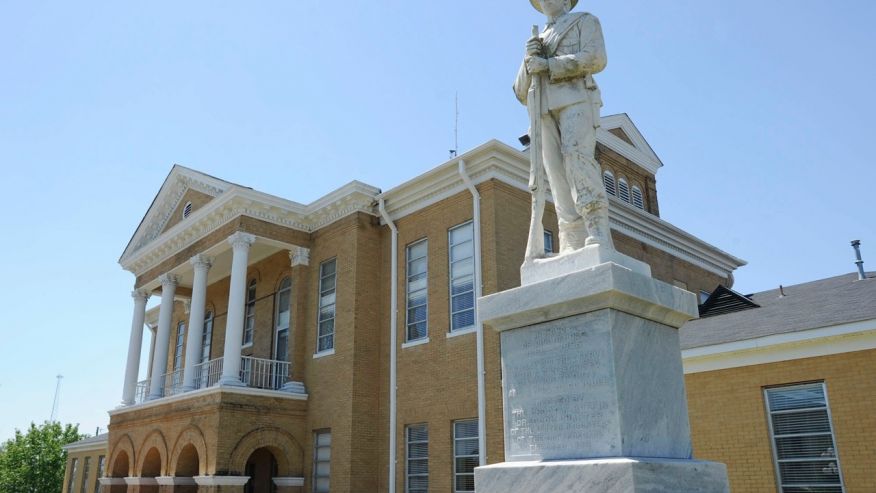
Old Times Here shouldn’t be Forgotten: But they shouldn’t be Celebrated Either

I spent the good part of my week trying to decide how I feel about the proposed removal of confederate monuments.  I was raised under their shadow, and they were touted as the good old days, back when modern day inconveniences and turmoil didn’t exist.  An impressionist painting of perfection.

I grew up in a small Southern town. It had giant magnolias, columned front porches, and an annual spring pilgrimage where visitors toured antebellum houses amidst blooming azaeleas and sweeping hoop skirts.

It was all nostalgia and watercolor sunsets and giant oak silhouettes. It was the land of cotton where old times are not forgotten. I was a ten-year-old with a mad crush on Scarlett O’Hara, and it all looked so pretty to me. It felt pretty to me. It was pretty perfect to me.

Frankly, my dear, I was wrong as fuck.

‘cuz it ain’t just whistling dixie we’re talking about here, folks.

It’s hate wrapped up in a pretty plantation package with a taffeta bow. And yes, people love to paint that heritage and history soft-focus picture of the gallant South. Love to talk about those good old days of prosperity and tobacco and cotton fields as far as the eye can see. To look back to the days of fine gentlemen in gray who knew how to act like fine gentlemen and lovely ladies in lace who knew how to act like lovely ladies.

But the problem with soft focus is, it’s fuzzy, y’all. The clarity’s not there. Sure, it shows the barbecue parties at Twelve Oaks and grand, double staircases. It shows the gallant young men marching their way into battle to defend their women and their land. It shows the rolling, red clay hills newly plowed with cash crops aplenty.  It shows all that highly-touted history and heritage.

Which is why they demand that these statues remain. They want to honor these outstanding generals who fought to protect the South’s genteel way of life. That genteel, civilized way of life where the fuzzy brush strokes sweep right past the whipping of the field hands and the raping of the house slaves and the selling of “darkie” children for the price of a spirited roan stallion. Where infant slave children were used as gator bait. Where an entire population (or at least those who survived) was raped, broken, beaten, maimed, and sold like chattel

Yet they continue their chant of history and heritage. Not hate. Never hate.

It’s history, yes. But it is also totally and absolutely hate.

So I say take them down. Take down all the Robert E Lees and Stonewall Jacksons, the Nathan Bedford Forrests and the Jefferson Davises. Put them in a museum somewhere.

They need to exist. They do. Because they need to remind us to never repeat such a heinous system of government again. Because that’s what it was: heinous.

Take them out of our town squares. Out of our city centers. Definitely out of our hearts.

Put in their place empathy, compassion, love.

And then put yourself in the place of descendants of slaves. Imagine yourself in their shoes, with whole histories of manacled and murdered ancestors lost and forgotten beneath that marbled pedestal of pride and privilege.

Imagine yourself a descendant of an untraceable ancestry, split, broken, drawn and quartered at the whim of the white man– husbands, wives, mothers, fathers, infants, siblings all lost. Where are the monuments to them? To their sacrifice? For sacrificed, they were — readily and continuously to maintain that sweet southern way of life.

No, the only monuments their descendants will see in nearly every southern square around, all honor the men who led the campaign to maintain the status quo — the dismemberment and death of their people.

If you still think those statues should remain where they are, I am ashamed to call you my neighbor. And you should be ashamed of yourself, too. It’s disgraceful.

And the South has seen enough disgrace. It disgraced itself when it seceded from the union. It disgraced itself with its Jim Crow laws. It disgraced itself with the incorporation of rebel flags into state flags.

For the love of all that is holy, let’s do something right this time around. Take the damn things down and put them somewhere where we’ll remember not to celebrate them, where we’ll remember that all that is gone with the wind needs to STAY gone with the wind.


Sunday Night Baking for our Inside Linebacker Boys

This week, the 2017 football season officially kicks off. And that means that from here on out, on any given Sunday, you’ll find me in my kitchen baking up treats for my husband’s players.

He coaches inside linebackers – those middle of the defense playmakers, ever ready and willing to bounce blockers, blitz quarterbacks and tackle large quantities of fullbacks and fudge brownies.

And I love baking these boys some sweets as much if not more than they love eating them. Baking is one of my all-time favorite pastimes. For me, it’s a form of love. I bake for people I admire and respect, and I bake for people I appreciate. And I always, always bake for people I love: my children, my friends, and now, Cartersville’s inside linebackers.

I mean, what’s not to love? What’s not to respect? They work hard and they play hard. They take their knocks and they get back up again. They understand discipline and commitment better than men quadruple their age. They are well-studied and they are selfless. And I figure baking up something special on a Sunday afternoon is the least I can do to let these young men know how much I appreciate what they do for their teammates and for their coaches.

It’s a tradition I began last year when my husband joined a team more focused on family than any we’ve ever been a part of.  We are a community and my baked goods are my attempt at communion – at feeding their souls with foods consecrated by love.

This coaching crew is qualified in so many different areas, but I must say that one of their finest talents is building relationships with the young men who risk limb and ligaments for a ballgame.

A ballgame, yes — but it’s so much more than a ballgame, as well. It helps these young men realize the importance of being a part of something bigger than themselves. Everyone is an integral part of the team. They work hard. Together. They grow strong. Together. If they win, they do it together. If they lose, they do it together. They are a team.

The offense doesn’t win without the defense. The defense doesn’t score without the offense – well, sometimes they do, but that’s beside the point. The point is, they are all needed: the quarterback, the h-back, the receivers, the linemen, the corners, the linebackers, the nose guard, the kickers. They are all part of the team. Without each one of these positions, the game would flounder and fail. It would be nothing but a muddled up mosh pit of egos stomping their feet and flailing their arms, and ramming and jamming at one another — with absolutely no point and no progress.

Kind of like the world was this weekend. A world full of egos. Look at me! See me! I matter! No one else matters but me!

It’s becoming abundantly clear that there are vast numbers of people out in this world who know nothing about hard work, toughness, sacrifice and teamwork.

Life is a contact sport. It is hard. It is tough. And it requires sacrifice and teamwork and love.

But the greatest of these is love.

And that’s what I admire most about these Cartersville coaches and their football philosophy: the love they give their players. And they’re not afraid to show it. I’ve seen it from the stands, and I’ve seen it in the field house. I’ve seen it at practice, and I’ve seen it in games. They love their players. A lot.

And to quote a little Seuss, unless someone like them cares a whole awful lot, nothing’s going to get better. It’s not.

I’m starting to think the world needs more football. And a whole lot more coaches like Canes coaches.


Football Gives me All the Feels: Confessions of a Coach’s Wife

It’s the beginning of the football season once again, and there’s not too much I can say about the football life of a football wife that I haven’t said before.

You already know I love it. And you already know it makes me crazy. Some days I can’t sing its praises enough. Others, I want to wring its disembodied little intangible neck. It robs me of time and it showers me with blessings.

It is a paradox of ginormous proportions.

This past Sunday morning I sat on my back porch, the silken and slippery humid air settling and sliding off my limbs, making everything feel slow and sweet simply because it was Sunday morning.  You know, all easy like.

So I breathed in the easy. I breathed in the sweet, succulent calm, and I held it deep down in core of my soul.  And there it remains. My future calm in the storm of the impending football season.

Wordsworth was fueled by powerful emotions recollected in tranquility. Me, I’m fueled by the opposite: tranquility recollected during powerful emotions. Because starting tomorrow, and for the next five months, my life will be FILLED with powerful emotions. Wave after wave of powerful emotions. No doubt about it.

Starting with love. I’ve always had a hard, strong love for the game. It began in middle school, when I fell hard for the Dallas Cowboys of my youth and the TCU Horned Frogs of my hometown. This was no puppy love. It was true and it was deep and it was eternal.

And with that love comes butterflies – a tickling, nervous anticipation every, single game night. When I see those stadium lights, haloed in the gloaming, sparkling with the wings of a thousand frenzied moths, saluted by the cheers of a thousand frenzied fans, my belly goes downright giddy.

But along with all the love comes intense jealousy — jealousy of the time it steals away from our family, the demands it puts on the man we love most. It keeps him from us for most of the week and it keeps him from most of what our family holds most sacred: meal times and bath times and story times and bed.

He came home late the other night – for the third time this week — calves flecked with paint from lining the field. It was well past the boys’ bedtime. They had missed him. Again. And they had said so. Again. Several times. And it’s only the first week of many, many weeks we will miss him this season.

So yeah, I get jealous sometimes — of the time that it takes. And sometimes it makes me sad. And sometimes it makes me mad. Like that other night, when Mike came home late, all paint-flecked calves and sweat-stained shirt and flat-out worn-out…

But when I saw him, a calm settled over me, my Sunday Morning Calm. I remembered. I remembered that this is my love — this man and this sport. This is my life and this is my destiny — a destiny written long ago, in the helmeted stars of America’s team.

Yep, football makes me crazy. And happy. And angry. And happy. And jealous. And happy. And frantic. And happy. And, well, you name it, I feel it. All the feels. The great, big, powerful feels. Except for sorry. Football never makes me feel sorry.


Choice Cuts in Education: Discrimination is Alive and Well in the State of Georgia

In the state of Georgia, discrimination is alive and well and driving our school systems. And it’s not what you think.  Schools don’t discriminate against students based upon race, creed, color, economic status, or national origin. But they do, however, quite openly discriminate based upon course load.

You see, Friday afternoon, I opened an email from the State Department of Education and what I read blew my mind and hurt my Humanities heart. I am outraged and appalled.

The email states, and I quote, “In the past, funding has been provided by the legislature Tfor one AP exam for all low-income students enrolled in Georgia public schools.  Recent legislation redirected this funding to support only STEM related AP exams for all students regardless of economic status.  Hopefully, this notice will provide time for you and your administrators to explore other funding sources to support your non-STEM, low-income AP student exams.”

Wait, what?  “Recent legislation redirected […] funding to support only STEM related AP exams[…] regardless of economic status?” Excuse me?

I had to read the email twice. And then I had to seek confirmation from my principal to make sure I was indeed seeing what I was pretty damn certain I was seeing? Because it seemed impossible. Impossible to believe that our state would take away funding from our worthiest and neediest students. Students who have been diligently bettering themselves, year after year, through education. Students who have been climbing their way out of the darkness of poverty by taking challenging AP classes (and yes, many of these students take STEM classes, but not all) just to have the final rung on their ladder toward success removed: the ability to test, receive college credit, and get out of the vicious cycle.

And just what is so special about STEM anyway, that it supersedes all other course work? STEM — that educational juggernaut that harnesses the four horsemen of accomplishment: Science, Technology, Engineering & Mathematics. Those subject areas that in recent years equate to the Holy Grail of education, warranting such teacher and student incentives as signing bonuses, higher salaries, excess funding, partnerships, scholarships and now, apparently, AP exam exemption status.

Believe it or not, high levels of rigor exist outside STEM classrooms, ladies and gentlemen: critical thinking skills, advanced problem solving, the ability to gather and evaluate evidence, interpret and apply that evidence. These skills occur in other subject areas, too.

Yes, STEM is vital. I get it. It drives innovation and industry and helps keep the United States at the top of the global leaders. But STEM is not the only thing that keeps us there.

The Humanities and the Arts teach us what it means to be global citizens. Courses in history, literature, music, philosophy, language, rhetoric, and art provide instruction in civility, altruism, ethics, reflection, adaptability, etc. They strengthen our ability to communicate – with ourselves and with other nations. They keep us balanced. Without these valuable tools, we quite likely would become a nation fueled by xenophobia and driven entirely by rationality.

And what could possibly be wrong with a nation that looks out for its own best interest, driven entirely by the bottom line, you ask? A lot.

Read Jonathan Swift and you’ll find some answers. He warned us over and over of the harm that can befall mankind if we only use the rational parts of our brains.  Read “A Modest Proposal,” where he pens a brilliant, satiric remedy for an over-populated Ireland by suggesting the Irish Catholics breed children (something they are already so naturally good at) for the soup pot and barbecue joint and monetary gain. Completely rational and cost-effective, mind you.

Read Gulliver’s Travels. Within its pages, there are multiple accounts of societies driven by — and completely destroyed by – the pursuit of science and technology and ice-cold rationality.

Read: it’s fundamental — and as a humanities course, it’s a dying skill.

Not all of us are STEM people, nor should we be.

And I’m not a STEM hater. Far from it. Some of my best friends are STEM people. So is my daddy. Hell, so is my daughter. But I’m here to tell you we need balance. Humanities and the Arts deserve a place at the table too, folks.

And, to bring it all back to Advanced Placement, where my argument began, our state legislature and DOE have taken Humanities and the Arts off the table for our economically disadvantaged students. They will be force-fed STEM or they will not eat. And that is wrong.

These exams are not cheap ($93 each), and while there are reduced costs in place for students who qualify through the Free and Reduced Lunch program, the biggest incentive – one free exam for each economically disadvantaged student testing – is no longer available thanks to our state’s new STEM reallocation.

I’m sorry, but STEM is not the Be-All and End-All of education. It should not be funded at the expense of other disciplines. Nor at the expense of our economically disadvantaged students.


A Cost/Benefit Analysis of Human Lives: Woodland High School vs GDOT

Woodland High School is located on a thoroughfare that is in the process of being widened into a four-lane bypass, complete with 44-foot median and 55 mph speed limit.  We have 1500 students at our school: young adults full of hope and promise. They are our future. They are our present. They are their parents’ everything. Every year 1/3 of these students will be driving to and from school. 100% of these students are young and inexperienced drivers. Science tells us their frontal lobes will not fully mature until they are 25. They do not necessarily understand their own mortality. Young people are risk takers. They have been so since time immemorial.

Driving this bypass will be tractor trailers – 80,000 pounds of engine and steel barreling toward society’s most vulnerable drivers. Drivers notorious for making errors in calculation and errors in judgment. One need only check insurance rates and accident statistics to understand the risks that are anticipated and documented amongst this demographic. An average of nine teens (ages 16-20) are killed in automobile accidents  daily. Yet the Georgia DOT refuses to acknowledge the elevated risk of serious injury or death for our Woodland students.

For two years – ever since our Central Office learned of the plans to widen Old Alabama Road – we have requested a traffic signal be installed at our school out of concern for our young students. For two years, they have denied us. They argue that traffic lights are expensive and that the traffic and accident studies do not warrant such an expense.

Are you telling me that the lives of young sixteen and seventeen-year old adolescents are not worth $120,000 – the estimated cost of said light? According to internet sources, that would equate to .007% of the 2017 GA DOT budget. Now, I’m certainly no math teacher, I’m one of those English types, but I did consult one, and I’m here to tell you, that’s nothing more than a drop in the ocean for them. If you ripped a sheet of paper into 1000 pieces, it would be seven of those tiny bits. But it’s a mega big deal for us. It’s life and death.

I teach approximately 180 high school students every school year. And I’m here to tell you that every single one of these students is irreplaceable. Every single one of them enriches my life. Every single one of them will impact the world. Their value is impossible to calculate. I will tell you this: $120,000 doesn’t come close.

As teachers, we have been chosen. We are following our calling – to save the lives of children through education. We have vowed to give them the tools they need to secure their futures, to fulfill their destinies. We become teachers because we believe in the value and potential of every child. We are passionate about saving students from all sorts of situations detrimental to their lives: self doubt, self harm, harsh environments, poverty cycles, apathy, violence, etc. Rest assured, as teachers we will fight to save our students from this danger as well.  Educators do not give up.

Every year, each of us takes students under our wings, students whom we adopt as our “special projects.” Oftentimes, these are children whom others around them have deemed lost causes, who need more of our time and attention because they just don’t understand the good they can accomplish in the world, the value that they possess.

This traffic light has now become the “special project” of every educator at Woodland High School. Others may see it as a lost cause. Others may have written it off as unwarranted or argue (under all sorts of semantics and statistical mumbo jumbo) that the benefit of saving one human life is not worth the cost. As educators, however, we are not giving up. Our students matter. We invest blood, sweat, tears and love into these children so they can have a bright future. We refuse to see that future snuffed out in the blink of an eye because the Georgia Department of Transportation refuses to invest $120,000 in the lives of Bartow County’s children.

Please help us in our fight. Contact gwaldrop@dot.ga.gov and voice your concerns. Please.

All Aboard the Potty Train!

We just sent both boys off to daycare in big boy undies. Both of them! One sporting Captain America because we haven’t found Iron Man briefs yet, (so to him they’re the next best thing), and the other guy in day-old, slightly used Superman ones because he has OCD tendencies (and that makes them the only thing. Please don’t judge me.)

Now in case you haven’t figured it out, it’s been ALL ABOARD the potty express this weekend in the Candela household. It’s proved a cruel and rickety ride– and I’m still not positive we’ve reached our destination, but we’re getting close.

This morning, we tossed the engineer’s cap to the boys’ long-suffering and sweet-natured day care instructors, along with additional supplies: some stickers, a couple of magic bracelets, and plenty of extra underwear, which I pray they won’t need because no matter how many channel locks and sleeper holds they employ, they will NOT be getting additional briefs on our youngest boy. Truth. I apologize in advance. We clearly owe their teachers some Martin’s chicken biscuits (for those of you not from around here, they are our breakfast equivalent of an In N Out burger. Although these women actually deserve a bottle of private-select, high-quality bourbon — but I believe that’s frowned upon by the State Department.)

Now I feel I need to clarify just a bit before proceeding further. Parker has been out of diapers for the entire summer. He’s been chugging along like a champ, except for one thing (um.. actually two — number two — to be exact). So that was our goal for him: to go number two in the toilet. Tate, on the other hand, has refused to get on board all summer long — like adamantly — so we knew it was going to be a wild ride.

The train rolled out at oh-eight-hundred Saturday morning, with a meticulously-plotted plan in place. We knew we needed strategies, tactical diversions, and lots and lots of patience. It commenced with the disposal of the one remaining unsoiled diaper. We made a great show of it, each boy grabbing a separate Velcro tag and marching it to the kitchen, where we threw away the last remaining vestige of their infancy. They laughed and laughed. And I may have shed a tiny – microscopic, really – tear. Diapers are a hassle and an expense. But they’re also the end of an era… But I digress.

The boys laughed and laughed. Until it wasn’t funny anymore. Until I pulled the wool from their eyes… ahem, diapers from their ass.

“Stand up, Bug. Let’s put on your new Spiderman underwear.”

“I want a diaper.”

“We don’t have anymore, remember? You’re a big boy.”

“I’m not a big boy. I’m a baby. I want my diaper.”

“No, let’s put these on. You love spiders.”

Tate may love spiders, but he does not love Spiderman underwear. What commenced was a tremendous thrashing about and flailing of limbs that left my extremities bruised and him bare assed in the floor howling at the inhumanity of it all.

The potty train had left the station. And then stalled immediately due to a tiny human lying prostrate on the track. For fifty-three minutes. Truth.

Parker, on the other hand, was all about it… until he had to poop.

“Mommy, get the diaper out of the garbage.”

“Not happening. It’s too messy. See?” I take him to the trashcan, where I had intentionally poured Mrs. Butterworth all over it, knowing full well that I would need the evidence to back me up later.

He tried a new tactic. “Let’s go to Target and get some more.”

“We can’t. Target is closed. It’s Saturday.” (Small white lie.) “Besides, we have this magic bracelet. (Big white lie) Let’s put it on instead and then go poo poo in the potty.”

Parker is the more easily manipulated of our two fellas, so his eyes instantly lit up. He proffered his arm and away he and daddy went.

At last! We were off and rolling! Until we weren’t. Another delay. Parker sat there, chugging away, but that sweet little engine just didn’t quite believe he could. Not even with his magic bracelet. So he didn’t.

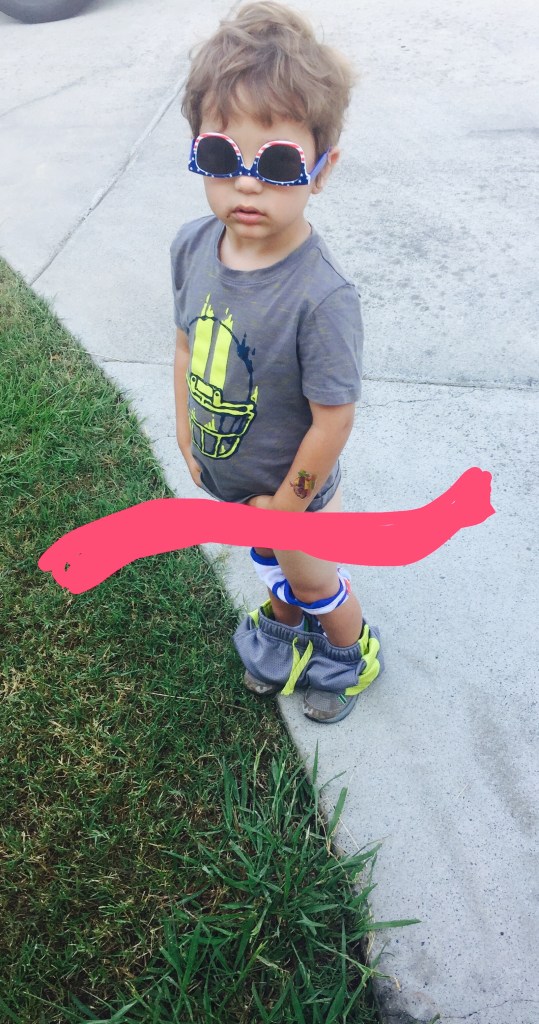
Tate, meanwhile, finally got off the floor but refused to get into his tighty whities — which, truth be told, are a little loose for his small frame and actually multi-colored. For the remainder of the day, he rode the train naked and full steam ahead, pulling ferociously at his safety valve all the while. But he found success – and stickers on a chart each time.

But rather than using the cute, little, froggy urinal we purchased – complete with spinning tongue to inspire good aim – he used the bushes outside our front door.

As Saturday drew to a close the ride left all four of us completely pooped (although only two of us had actually done so), and with the soil in our front bed growing more acidic by the moment. The gardenias should love it.

Cue our Sunday morning departure. It was a good deal easier on all the passengers. Tate finally fed the frog and even managed to spin its tongue, although it might actually be a uvula… it looks kind of like a uvula. Regardless, he did it. (Although he still prefers the shrubbery.)

FullSizeRender (7)

And Parker finally conquered number two atop the toilet – the magic bracelet managing to wield its powers — and got tatted up as a reward. And Mike and I actually began to relax a bit and enjoy the ride.

Yes, the potty express is finally proceeding full steam ahead. And I’m praying that having handed over the controls to our sons’ ever-faithful teachers, the forward motion will continue. I pray that the air brake isn’t somehow inadvertently tripped in the chaos of centers and snack time. I’m not worried about Parker. He’s pretty much got this. But Tate, he worries me a bit.

Earlier, when I mentioned his OCD, it wasn’t for dramatic effect. He has definite tendencies. Tate won’t do anything until he’s confident he can succeed. And once he’s mastered something, he does it, ad nauseam. We’ve recorded hours of him singing Elsa’s theme song. He’s completed his favorite ABC puzzle approximately two hundred thousand times. (I exaggerate. Let’s say one hundred. Thousand.) Last week I told you about the elevator that we rode over and over and over and over again on vacation. And when we weren’t riding it, he was talking about riding it. And begging to ride it. And screaming to ride it.

So I feel like it’s kind of the same with the potty express. He feels fairly confident right now. At least about the first part (we’re working toward no. 2). For a while over the weekend, he wanted to pee every three minutes – and his body wouldn’t necessarily comply — which caused him to stress a wee bit (yes, pun intended). But now, he’s relaxed into an every-thirty-minutes-or-so pattern. (We have a plethora of stickers to prove it.)

Our family boarded this train with the intent of promoting confidence and independence (and a new school level – age 3-4 class) for our little lads. And thus far, it is working. But if our youngest has a set back, his OCD tendencies may take over. He already worries nonstop about “pee peeing on the floor at school.” He gave me a running catalog of classmates who have done so in the past. And if he does, he’s sure to internalize it as failure and our entire train could derail.

So I would appreciate any and all prayers for a successful third day aboard the Potty Express. We could use all the assistance we can get. And please, please… send prayers, not judgment. I know they’re almost three-and-a-half. I know they should’ve been potty trained a long time ago. But twins are a lot of work, David. Have mercy!

Blog at WordPress.com.

Up ↑