Search

postmodernfamilyblog

Multigenerational Mom Muses on Twin Toddlers & Twenty-Something Daughters

Category

writing

The Writing Process: Fishing Serendipity and the Swampland to Serve up Batter-dipped, Panfried Truths

There’s this weird feeling I get sometimes. Like someone has hit a tuning fork — but the tuning fork is my body. And it rings and vibrates. Like a silver spoon hitting chilled stainless. Like ice hitting back molars. Like wintergreen hitting my veins. And the one hitting the tuning fork is the universe. Is God, if you will.

I feel awake and alive and almost raw.

So I go to my computer and I dive into the current of serendipity’s stream. And I pay really careful attention.

Words swirl around me, boomerang back at me like white water rapids. They carry me, roll me, drive me forward. The universe is in charge, and I am on a wild ride. Where I’m going is out of my hands – but I know I’m on the right track.

So I swim. Hard. And fast. To stay inside that current. Not sink beneath it.

Because the universe has given me a gift — it has given me a path and a process. But it has expectations. It has demands. And those demands are rigorous. They are… well… demanding.

This current will take me to my goal, but only with a whole lot of work.

So work, I do. At first I’m cold and rusty, and my mind misfires. A lot. But I remind myself I’m trained for this. I can do this hard thing. I am prepared. And so I just keep kicking, doing my best to stay afloat and follow directions as the words swirl around me, bump up against me.

Inside the current, my mind warms, loosens — perhaps even unravels a bit – allowing flexibility and vision and a bit of slack to reel in the difficult bits, the hard bits. Of life. Particularly, my life. My past.

Because the hard and difficult bits require a whole lot of slack — lest I get too wound up, too tense, and then break the line and lose the way, the truth, and the life. My way. My truth. My life.

Barbara Kingsolver once stated that “memory is a complicated thing, a relative to truth, but not its twin.” And I totally get it — especially when the memory itself is incredibly complicated, when the truth you are recording — the twisted religion of your formative years — was itself a relative to truth, but not its twin. Maybe not even the same family… or neighborhood. But definitely the same region. My truth fits within the region — the southern region, that is.

The South — where truths become memories, loosely maintained, that become yarns, wildly spun, that become tales, twisty and gnarled.  Where truths become monstrosities.

Here in the land of Faulkner and Flannery, we drill holes in mama’s coffin (and right on through to her face) so she can breathe in the hereafter. We have kinky morticians and corrupt bible salesmen and Presbyterian ax vigilantes. We have deaf mutes and hunchbacks and dwarves – oh my! All so we can safely unearth the darkened roots of our deep-seated insecurities.

Here in the South, we love a little batter on our vegetables and a little gothic on our histories. Sure, maybe raw is better for you – but they taste so much better in a solid bath of debauchery and a heavy dusting of sin. (Minimalist, we are not!)

It’s as much about embellishment as it is about fact here. We hide our tender bits inside hyperbole and the grotesque. The crazier the tale, the deeper the truth.

For me, swimming serendipity’s stream may begin with the exquisite chill of a spoon hitting stainless, but it never fails to dump me where stainless will always fall victim to stain: childhood and the fears and tears that form its fecund swamplands.

The water there is brackish and foul with trash and monsters. Monsters ready to be raised from the near-dead. Demons with watermelon rinds for smiles. Disciples with oily words and cardboard hearts.

I land there each and every time. And after I catch my breath and adjust to the temperature change, I dredge the swamp.

And as the silt and sludge swirls, I bring in my haul — words writhing and thick with hard muscle, slippery sinew, scaly gill. They emerge slowly, but in netfuls, tangled and twisted. Words glinting with a thousand splendid refractions, bending and contorting in the light. Piercing.

I capture them all by capturing my past. Finding the way and the truth from my life.

My biggest and most-tangled of truths thus far — a Pentecostal pastor’s circumcised daughter — flesh faulted and excised amid great ceremony and pain. She emerges from the darkness demanding her reckoning. She flips silver on my screen.

She is forged from the cold steel of serendipity’s stream, humming with the frequency of the tuning fork. The chill of wintergreen hangs in the air… along with the sweetness and rot of the swamp.

I gut her and clean her. I batter-dip her in admonition and intuition and the blood of the Lamb. I sear her on tongues of flame. I lay her on a slaw of shredded scripture. And I serve her up to the world.

+ + +

In the beginning was the word.

And the word was made flesh and dwelt among us — howling to be heard. To be seen. To be known.

Ex nihilo.
 

Teaching English Composition: The Delicate and Demanding Job of a Voice Midwife

On dark days, I wonder why I blog.  Why I put myself through the peeling back of layer after layer of tender, hidden embryonic self-truths, exposing the fresh new bits to a cold, fickle world…

And no matter how much I tell myself it doesn’t matter whether my musings are acknowledged and well-received, it does. It matters a lot. Because everyone wants to be heard. Everyone wants to feel valued and validated. And when it doesn’t happen, it brings on floods of insecurities and self-doubt. Especially after the painful process of self-revelation.

It makes me question why I blog about my life at all? What do I have of value to offer up to the world? I’m not young and good looking. I’m not rich and famous. I’m no makeup expert or flashy fashionista. And I’m certainly not a ninety-something grandma in tie dye lingerie smoking weed and dancing the Charleston to gangsta rap. So why do I even think I can compete in this world of crazy gimmicks and material world wisdom? What the hell do I think I’m doing, blogging about my stuff — my boring, middle-aged mother stuff, the stomach bugs and family vacays and potty-training-woe-is-me stuff.

And hitting these dark, despondent days of doubt – these total eclipses of confidence, if you will — makes me consider my students. Because my paying job is teaching high schoolers to find and use their voices through literature and composition – and I take my job very seriously. And they despise me for it – particularly the composition part. They act like I’m tearing out their fingernails with a pair of needle-nose pliers, followed by a chaser of hydrochloric acid.

If you want to know what the shrieks belched out from the bowels of hell sound like, step into my classroom the morning I announce an essay assignment. Lord, the bellyaching.

And I get it. I honestly do. If it’s done right, writing’s a painful process. I’ve felt the needle-nose pliers and hydrochloric acid many times. But it’s also enlightening (which is precisely why it’s so painful) for both the writer and the reader. The more you write, the more you know – not about the world (though that happens too) – but about yourself. Who you are. What makes you tick and why. All sorts of unacknowledged truths claw their way to the surface when you write. It’s like you’re giving birth to yourself. So of course, that’s gonna hurt. Like, a lot.

But pain is this generation’s enemy. They run from it. They prefer high GPAs with minimal effort and zero pain. And I’ve discovered that quite often, that’s what gets served up. They hold out their tray, they get their perfect little A.

(I once had an AP student brag to me that in an honors English class she never once turned in a weekly journal assignment — what should have totaled 16 zeros on her report card — yet she still walked away with a 100 in the class. And naturally she adored that teacher. Why wouldn’t she? An easy A equals a happy student, happy parents, and therein, happy teacher.)

And this scenario is not that uncommon, folks. Teachers are not making their students write. Why? No pain — and pain-free seems to be the way of the world right now. Consider all the scheduled C-sections with full makeup and perfectly coiffed hair. (I know, I know… there are necessary c sections, I’m not saying there aren’t – I had one with the boys this last time around, but so many are simply the easy way out…)

But I’m here to tell you there are no scheduled c sections in my English class. My students are going to birth their ideas one painful quote incorporation at a time. But I promise you, when it’s over and done, it will be worth it. Birthing a voice is a beautiful thing. A beautiful, gut-wrenching thing.

But when we as teachers don’t require our students to go through that painful birthing process – or if we do, but then we don’t acknowledge that fledgling voice with commentary, both critical and complimentary — then we are teaching them that their voices don’t matter.

And we are teaching them that they can do absolutely nothing and succeed at life.

And neither of these is true. And I honestly don’t know which lie is worse, but as a person who’s been denied a voice when I was exactly their age, I tend to think it’s the first. Voice matters, people.

Like I said, I know what it feels like to believe my voice doesn’t matter — to feel pointless and small and ready to quit. To feel powerless.

But I don’t quit when I start feeling small and weak and ineffective because I have enough willpower and confidence, and I have enough love of self and craft to overcome the doubt. I have age and wisdom on my side, brought about by teachers and loved ones who believed in me.

But our students seemingly have none of these.

Our job as educators is to empower. By not having students write — or by requiring they do and then not grading their work — we teachers are failing our students. If the essays aren’t being evaluated and validated – if they are not receiving written commentary, if the students themselves are not getting the time and attention and INSTRUCTION they so deserve (and so many are NOT), then what exactly are we teachers teaching them?

We are teaching our students that they are not worthy of confidence and self-respect and a future. And the saddest part about this situation to me is that our students are okay with that. Because it is easier.

Writing papers is hard work. Grading papers is hard work. Taking a student from point A to point Z in a semester is hard work. But guess what? Education and educating SHOULD both be hard work. It’s a job. So we need to do the hard thing to the best of our abilities. All of us. Teachers and students alike.

This year, due to unique and unavoidable circumstances, I face a teaching schedule unlike any I’ve ever held before. I am teaching two separate courses (nothing new there), with two high stakes exams tied to each course at semester end (that’s the big stressor, here).

I am a bit overwhelmed, to say the least. It would be really easy for me to say that there is just way too much grading involved and way too many students to accommodate. That this is only a temporary schedule, so I’m simply going to coast my way through it all. I’m just going to give it a lick and a promise, keep the parents off my back, keep the kids happy with completion grades, and chalk it all up to doing the best I can under the circumstances.

But I would be doing myself and my students a disservice. And I’m not ok with that.

Because while these kids would be happy with their easy As — and all the accolades and scholarships and privileges that come along with them — that sort of teaching philosophy also gives them little to no true skill sets, no true self-respect, and no true future. And I refuse to do that. To them or to me.

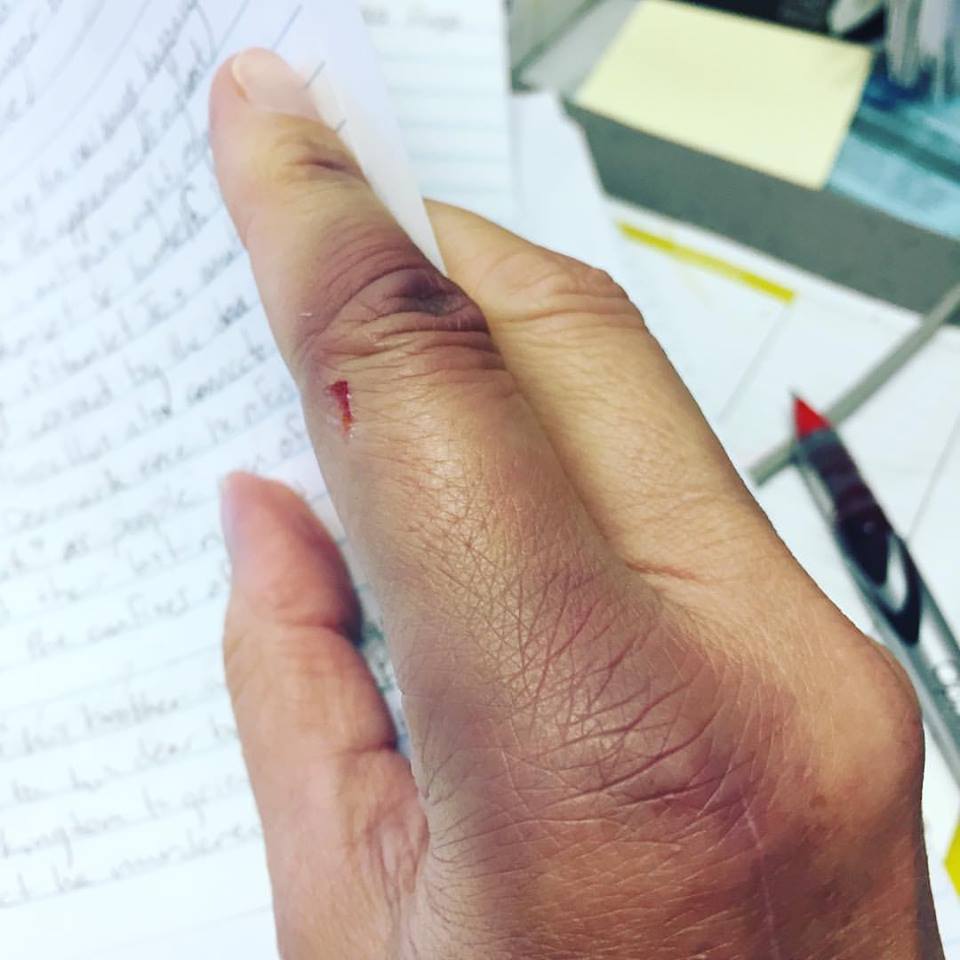
I have an incredibly tough year ahead of me. And so do my students. Because they will write. And I will grade that writing. That’s my job as an educator: I am a voice midwife. I coax, cajole, demand, deliver. They are birthing their voices, their identities. It’s not easy. But nothing worthwhile ever is. And they and their voices are worthwhile.

So pardon me while I pick myself up by my ballpoints and crank out some commentary on the pile of newborn essays just screaming for some attention.


Why I’m Afraid of the Dark: True Southern Gothic

The summer solstice is here. That means summertime. Where the days are long and the nights are sticky. Pools and fireworks and barbecued weenies. Mermaid days. Firefly nights.

I love me some summer. Always have. As a teacher, I love them even more than ever. They are my chance to relax and recover. They are unbelievably important to my state of mind.

But I remember one summer way back when that totally wracked my state of mind. It was the summer that ended my childhood. It was the summer before my sixth-grade year. It was the summer I heard demons in my living room. It was the summer I learned we were moving to a giant metropolis and leaving my friends and fun and beloved frog pond far behind. It was the summer of my fall.

Up until then I’d been knobby-kneed, sun kissed, and barefoot. I had three sisters, a new baby brother, and more than a mild addiction to lime Kool Aid. I wore my hair long and tangled and crunchy with chlorine. I loved horses and roller skates and Laura Ingalls Wilder. I knew nothing about life but what my small little patch of Yoknapatawpha had taught me: kudzu and snake skins and sandy creek beds; frog ponds and field corn and honeysuckle vines. My own little Garden of Eden postage stamp.

My friends and I – a neighborhood pack of elementary school vagabonds — roamed the backroads and the brambles in search of the most perfect summer. And we damned near found it amidst a syrup of sweat and random scents: deadheaded marigolds, sunbaked magnolia blossoms, warm pine needles, maypops cracked wide open on hot asphalt, and truckloads of mosquito spray, which we rode our bikes behind like we were soaring through clouds in fighter jets.  Those are the smells I remember from that summer. It was a summer full to the brim. Mosquitoes and memories multiplying under a speckled canopy of freckles and stars.

And then came the demons.

It wasn’t what you would think. It wasn’t howling and hissing and holy water sizzling on flesh. I saw that sort of thing later, in some Hollywood versions of possession. No, this to me was, and still is, far scarier. Because it happened. To me. In real life. And it was nothing like in the movies.

It happened in a run-of-the-mill southern den, amid a velveteen sofa, a couple of flame-stitched wingbacks, and a good many, good-intentioned, God-fearing people. There was a laying-on of hands, a cacophony of tongue-speaking… and hissing. I remember harsh, guttural hissings. Lots of repetitive phrases, lots of In the Name of the Lords and Get behind me, Satans.

This is not something your average eleven-year-old should be exposed to. Just saying.

It left me terrified of the dark to this day.

It happened in our living room during a cell meeting – the little home prayer groups that were sprouting up all around our neck of the southeast back then. Led by people dissatisfied with the ways of organized religion. Rather ironic, considering they organized their own, new brand of religion, which ended up leaving me terrified of any and all organized religion.

It was just a small gathering of people I’d grown up around. And they were there, in our living room, worshipping God in the way they thought best. Lots of singing, praying, lifting of hands, and speaking in tongues. I was used to it.

Until it took that turn. That devilish turn. I remember – or maybe I invented — a smile. The biggest smile you ever did see on the biggest, best man I ever knew. A great, big-bellied, big-hearted man with a great big watermelon smile. Only this smile wasn’t his smile. It was creepy and folded in. Like a jack-o-lantern two weeks too old.

As dozens of men surrounded the smile, and dozens of women prayed fervently, that smile broke my innocence. And I can never go back.

To this day, I can’t watch possession movies. I just can’t. Give me all the Criminal Minds and Law & Orders and Sherlocks you’ve got. I lap them up — my adult version of lime Kool-Aid. I am more than mildly addicted. But possession flicks? Nope. Not happening.

And whenever I wake at 3:00 AM – the witching hour, the devil’s hour — I shiver and slide over closer to my sleeping husband, terrified of the knowledge I absorbed way back then.

It can’t be undone. It can’t be dismissed.

Were the demons real? Who knows? I was told once that I was possessed, too. I was pretty sure I wasn’t. Still, it was scary as all get out to be told that. And to witness all that I witnessed. For there were far more exorcisms than just the one.

And this summer, I’ve been revisiting that time — working on a novel that integrates some of those same situations and the ensuing darkness that enveloped me.

It all began with a grinning demon. And it all ended with a damsel in distress.

It took her years to escape. She’s still working on it, actually.

I Won’t Sit Still and Blog Pretty

One year ago, today, I published a blog for the first time. Yesterday, I was told I should be quiet for the first time (with regard to my blogging, anyway…)

Inevitably when I write about something hard – whether it’s the death of innocent children or the dearth of wisdom in the White House – someone disagrees. Someone challenges my voice.

And I know that’s the nature of communication. People will inevitably disagree with you. And they have that right. That doesn’t mean I still don’t have the right to explore my thoughts and opinions and to voice them.

I write this blog for myself. It is therapeutic. It is cathartic and healthy. It is a way for me to use my voice. Because there was a time – for a very long time, actually — when my voice was silent. It was too squashed and maimed to be used.

It took a long time to build up my vocal chords, so to speak. So much so, that now, when I say something that I feel is important and needs to be said – and it strikes chords or nerves in others — I don’t know how to react; how to respond. If it is acknowledgement, I feel embarrassment. I was taught to be a wallflower. To blend into the background.

And if it is a challenge, I shut down. My brain immediately crackles and hums with the static and white noise of learned ignorance. I was taught that my thoughts weren’t thoughts. They were emotions. I was a hormone-fueled woman driven by emotions; I was unbalanced. And because of that unbalance, I should just still and look pretty. Don’t stand up, don’t speak out, I was warned.

Senator Elizabeth Warren was famously silenced on the Senate floor this year. At her workplace, where she rolls up her sleeves with nineteen other women and eighty men who were elected to ensure that all of America’s diverse voices are heard. Ironic, don’t you think?

But Senator Warren doesn’t play nice when the patriarchy puffs its chest. She has fight in her. She breathes fire. And if they try to snuff it out, she just flares up somewhere else. So when they silenced her on the Senate floor, she took it outside. (Isn’t that what men do when they get pissed and want to fight? They take it outside? Isn’t that the euphemism?) Well, Elizabeth Warren got pissed, was determined to fight, and took it outside. She fought the establishment. She fought the patriarchy. Even when she was warned (as the majority leader so infamously stated), nevertheless, she persisted.

Today is my one year blogging anniversary and I, likewise, will persist. This blog helps me. It helps me process my opinions into words on a page. Words that help me stay the course and press forward. Words that help me work through my overwhelming feelings of inadequacy. And as I write out those words I edit and edit and edit. I am as careful and calculated as a baker.  I sift and weigh and measure and adjust – until I’m confident that what I’m saying is what I truly want to say. What I truly believe. And that it is as palatable as I can possibly make it – even though I know it’s not going to suit everybody’s taste.

Now I won’t lie and say that it doesn’t bother me when someone criticizes. Nor will I say that it doesn’t feel good when people approve. It feels nice to have my opinions acknowledged. my passions and feelings accepted. (Yes, I voice those, too – because I have learned emotions do not make me a weak, hormonally-imbalanced woman; my emotions do not invalidate my opinions). But I do not blog for the “likes” or the comments, or to try to “go viral.” If that were the case, I would be failing miserably because I am a far cry from viral, let me tell you. I have no cult following – or really much of any following. But none of that matters to me.

What matters is that I have a voice. And I have the right for that voice to be heard. And I do my utmost not to offend people. I really do. (Remember that baker’s analogy?) I have been rash at times, though. I admit it. Particularly in the days following the election. Several of those blogs may have cost me a friendship or two. And I wish that were not the case.

But that still won’t change how I think, and why I think, and the fact that, yes — in spite of all attempts to program me otherwise — I think. And believe me, I think long and hard about what I’m going to say on my blog. Because voice is powerful stuff. We all know the pen is mightier than the sword. So I try really hard not to wound.

There’s a poem by Eavan Boland I love called, “It’s a Woman’s World.” It fights female stereotypes in many clever and determined ways. And it argues that “as far as history goes, [women] were never on the scene of the crime.” We’ve never held the sword. As a result, “no page scores the low music of our outrage.” Boland goes on to argue, however, that despite the attempts to conquer and control our tongues, we women are fire-eaters. Our mouths are burning plumes, and we will be heard.

Elizabeth Warren is certainly a fire eater, a flame thrower. She knows the fight will be hard. She admits “there’s going to be a lot that we will lose. But I guarantee, the one thing we will not lose, we will not lose our voices.”

I believe we all have been given gifts from God, gifts we are programmed from the depths of our genetic markers to use, regardless of our upbringings and hardships. I believe mine is my voice. And although mine is not necessarily an audible one, it is a voice meant to be heard. And I will project it through written word.

I will not lose my voice ever again.


Blog at WordPress.com.

Up ↑